

On Bottlenecks
Criticality investing, bottlenecks, and progress

Due to the nature of how complex systems (like the economy) evolve and propagate change, the vector of progress naturally reaches “bottlenecks”—points of friction which need to be surpassed for progress to continue. Often, these bottlenecks are not visible to the whole market but are only known to insiders and industry practitioners. For a while, these bottlenecks typically remain suppressed (from market attention) and unaddressed by physical and/or social technologies.
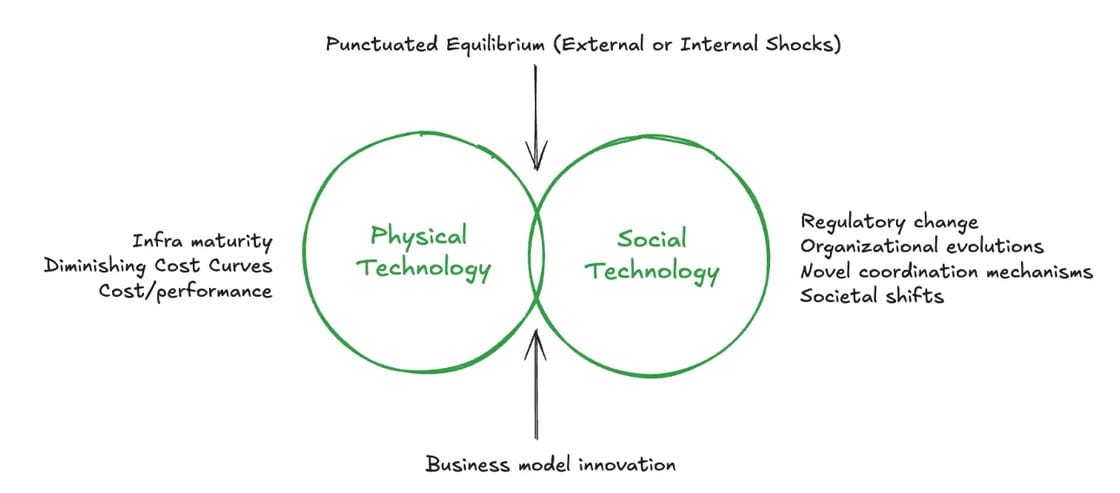
Two provide two recent discrete examples from our own data (automatically generated by Level intelligence):
As AI datacenters move from 800G optics to 1.6T optics (and longer-term toward silicon photonics and co-packaged optics), this increases dependence on indium phosphide (InP) lasers and related devices. The bottleneck is not raw indium, it’s InP laser manufacturing capacity (wafers, epitaxy, packaging and talent) scaling much more slowly than AI optics demand.
Physical AI deployments in most domains are not bottlenecked by model capability by rather human ownership and trust—driving integration, workflow change, and safety validation across messy real-world environments. At scale, deployments are constrained by the ability to staff and operationalize the ongoing human-in-the-loop layer as a repeatable program with workable unit economics.
These opportunities, and others, can be areas of important value capture if the addressable markets are sizable and the market structure lends itself to companies with positive feedback loops. As we have also written about in Criticality Investing, criticality implies that bottlenecks/tensions are unobserved, which is why they are considered latent. The stronger and deeper the latent tension, the more activation potential (convexity) can result if there is a criticality event resulting in narrative/attention and capital rotation.
As we have discussed, the attention of the market is typically converged on first/second order narratives, ignoring other potential limiting factors to progress. This is because narratives, by definition, are designed to be overly coherent, allowing them to capture market attention and reduce the complexity of investing decisions. Attention is often mis-priced—capital increasingly chases what captures attention while less visible opportunities tend to be suppressed, until they become too impossible to ignore. Once attention rotates, there unfolds a rapid experimentation and business creation phase.

At Level, we believe that an important source of convexity lies in identifying businesses that are addressing latent tensions (due to physical and social technology bottlenecks) that will become mainstream once market attention refocuses. We continue to develop large-scale systems to discover these opportunities and monitor the companies tackling these problems.